
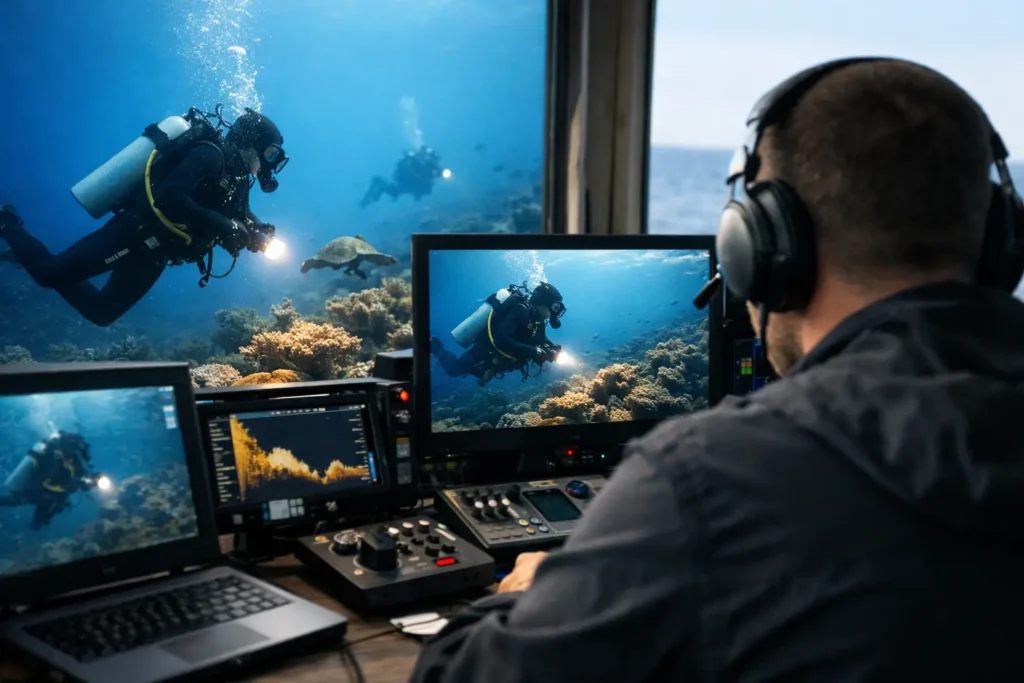
You loaded the car, packed tanks, texted your buddy, and drove an hour to the coast only to find green water and zero visibility. That kind of miss is exactly why real time dive reports matter. For divers, snorkelers, and freedivers, the difference between a great session and a blown plan often comes down to timing, local knowledge, and having the right read on the water before you leave home.
Standard marine forecasts can tell you plenty about wind, swell, and tides. What they usually do not tell you is the part ocean users care about most once their face hits the water – what it is actually going to look like down there. You can have manageable surface conditions and still end up with churned-up, low-visibility water. You can also get a mediocre-looking forecast that turns into a surprisingly clean window if the tide, angle of swell, and local geography line up.
That gap between general forecast data and actual underwater conditions is where real time dive reports become useful instead of optional.
What real time dive reports actually tell you
A good dive report is not just a weather snapshot with a different label. It translates changing ocean conditions into something actionable for people deciding whether to suit up, where to enter, and when to go.
The most useful reports combine visibility observations, recent photos, local timing, and supporting environmental data. If someone reports 20 feet of vis at 8 a.m. on an incoming tide, that matters more than a raw wind number by itself. If another report shows that the same spot turned murky by noon as swell picked up, that gives you a usable window instead of a vague forecast.
This is why timing matters so much. Conditions at sunrise can be completely different three hours later, especially near reefs, jetties, coves, and river mouths. Real time reporting helps ocean users stop thinking in full-day forecasts and start thinking in narrow windows.
Why forecast apps alone are not enough
Most weather and surf apps are built for broad coverage. They are good at surface-level prediction and less useful at answering a diver’s actual question: Will I be able to see anything underwater?
That is not a flaw so much as a limitation. Visibility depends on more than one variable, and those variables interact differently from spot to spot. Tide direction, previous-day swell, onshore wind, runoff, sand movement, and local bottom structure can all change the picture fast. A clean-looking marine forecast might still produce bad vis at a beach break. A protected cove might stay clear even when nearby open coast spots are messy.
Real time dive reports add the missing layer. They bring local context into the decision instead of forcing you to piece it together from five tabs and a guess.
Real time dive reports and visibility windows
For most ocean users, visibility is not just a nice-to-have. It shapes the entire session.
Freedivers care because murky water can kill the experience and tighten safety margins. Snorkelers care because there is no point swimming over a reef you cannot see. Scuba divers care because bad visibility changes navigation, buddy awareness, photography, and comfort underwater. Spearfishers care for obvious reasons, but even casual swimmers notice the difference between inviting blue water and churned-up soup.
The useful part is not only knowing whether a spot is clear right now. It is knowing whether the conditions are trending better or worse. That trend line helps you decide whether to leave immediately, wait for the tide switch, or skip the spot entirely.
This is where a practical report beats a static reading. A number on visibility helps. A report that says visibility is improving through mid-morning on a cleaner incoming tide helps you plan.
What makes a dive report trustworthy
Not all reports deserve equal confidence. Some are too old, too vague, or missing the local details needed to make a real decision.
The best real time dive reports usually share a few traits. They are recent. They come from people who were actually in the water. They include plain-language notes about visibility, surge, entry conditions, and current. And ideally, they are supported by broader environmental signals so one person’s opinion is not the only input.
That last part matters. Community reports are valuable, but they can be subjective. One diver’s “pretty good” might be another diver’s “not worth the drive.” Experience level changes perception, and so does the kind of session someone wants. A photographer looking for crystal clear water has a different threshold than someone just trying to get a quick training swim in.
The smartest approach is to blend firsthand reports with data that explains why those conditions are happening. That gives you more confidence than either source alone.
Why local context changes everything
Two spots a mile apart can have completely different water clarity. That is one of the biggest reasons generic forecasts fall short.
A harbor mouth can push dirty water down the coast while a nearby protected cove stays clean. One beach gets hammered by west swell while another is shadowed and calm. A tide that improves visibility at one reef can make another spot worse by pulling stirred-up water across the entry.
Real time dive reports work best when they are location-specific and built around actual local behavior. That is the difference between a forecast you glance at and a planning tool you trust.
If you travel for dives, that local layer matters even more. Visitors usually do not know which spots handle north wind well, which entries become sketchy on a dropping tide, or which beaches look decent from shore but are blown out underwater. Reports from people who know the area can save a full day.
Better reports lead to safer calls
People usually think about dive reports as convenience tools, but they are also safety tools.
Low visibility changes risk. It can make buddy separation more likely, make exits harder to judge, and raise stress for newer divers or snorkelers. Strong surge and poor entry conditions may not show up clearly in a simple forecast summary, but they often show up fast in a local report from someone who just got out.
There is also the group-planning side. If you are coordinating with a buddy, you need more than “maybe it will be okay.” Real time reports make it easier to say yes, no, or not yet. That reduces last-minute scrambling and helps people avoid marginal calls just because they already committed the time.
For solo-minded ocean users, there is another layer. Better information helps you recognize when a spontaneous session is smart and when it is just optimistic.
The best real time dive reports combine people and data
This is where the category is headed. The strongest systems do not rely only on forecasts, and they do not rely only on community chatter. They combine both.
User check-ins tell you what the water looked like in the real world. Photo-based reports add proof and visual context. Environmental analysis helps project whether that condition is holding, improving, or about to fall apart. Put together, that gives you a much more usable read than raw numbers ever could.
That mix also saves time. Instead of checking swell, wind, tide, webcam angles, social posts, and text chains separately, you get one practical answer: is the window worth chasing?
That is the value of tools built specifically for underwater visibility planning. Searu takes that approach by combining local observations, photo reports, and AI-backed coastal analysis into a simpler go-or-no-go read for ocean sessions.
What to look for before trusting a report
If you are using any platform or local feed for dive conditions, a few details make the information far more useful. You want to know how recent the report is, what time the observation was made, and whether it includes actual visibility notes instead of generic “good” or “bad” labels.
It also helps to know whether the report captures trend and timing. Conditions that are fair at 7 a.m. can be poor by 10 a.m. If a report does not help you understand the likely window, it only solves half the problem.
Photos are useful too, but only if they are fresh and tied to a location. Old images can create false confidence. The same goes for community comments with no timestamp.
Stop guessing and start choosing better windows
Ocean time is expensive even when it is free. It costs fuel, prep, coordination, and often a shot at your one open morning that week. Real time dive reports cut down the guesswork by telling you what the water is doing now and, when done well, where it is likely headed next.
That does not mean every report is perfect or every call is easy. Ocean conditions change fast, and local variability will always keep a little uncertainty in the mix. But better information shifts the odds in your favor.
The goal is not to predict the ocean with total precision. It is to make smarter calls, waste fewer trips, and get in when conditions actually line up. That is a much better way to plan your next session than hoping the water looks as good as the forecast did on your phone.