
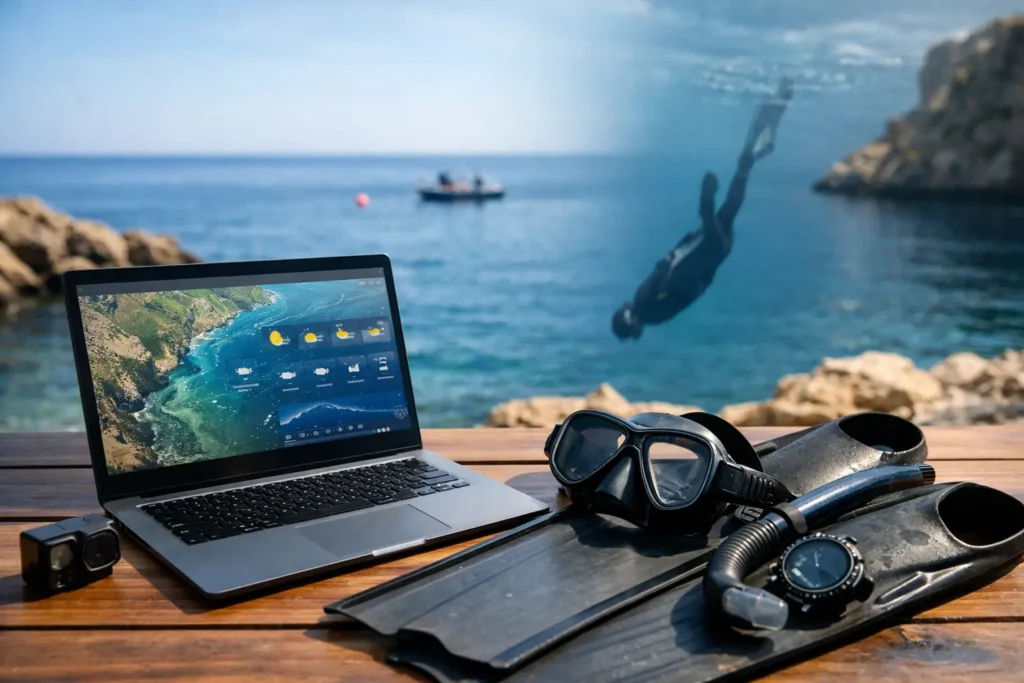
You can pack your gear, clear your morning, and drive an hour to the coast – then hit green water, surge, or a current that makes the session a bad call. That is why a freediving conditions forecast matters. Not as a nice extra, but as the difference between a confident entry and a wasted trip.
Most people still piece conditions together from a tide chart, a wind app, a surf cam, maybe a local text thread, and whatever guess feels right. The problem is that freediving is not just about whether the ocean looks calm from shore. It is about whether you will actually be able to see, descend, relax, hunt, train, or film once you are in the water.
What a freediving conditions forecast should actually tell you
A useful forecast does more than show marine weather. It translates surface conditions into underwater reality.
For freedivers, visibility is usually the first question. But visibility is not one single metric you can pull from a standard weather app. It changes with swell direction, wind strength, recent runoff, tide movement, bottom type, and how exposed the spot is. A cove that stays clean in one wind can turn to soup in another. A reef might look fine from shore and still be full of suspended sand below the surface.
That is why a good freediving conditions forecast should answer a more practical set of questions. Will the water likely be clear enough for the kind of session you want? Is the time window improving or getting worse? Will current, surge, or chop add stress even if visibility is fair? And is this a day to go with a buddy and keep it conservative, or a day to hold off?
If a forecast cannot help you make those calls, it is just raw data with extra steps.
Why standard marine apps miss the mark
Most marine forecasts are built for broad weather awareness, not underwater decision-making. They show wind, swell, period, and tides, which is useful. But freedivers still have to interpret what those variables mean for a specific entry, reef, kelp bed, jetty, or nearshore ledge.
That gap is where most bad calls happen. A low wind reading can look promising, but if the swell angle is wrong for your coastline, the surge may still be brutal. A small surf report can seem harmless, but if yesterday’s swell already stirred up sand, visibility may still be poor. An incoming tide can help one spot clean up and make another spot harder to enter.
So the issue is not a lack of data. It is that the data is scattered and not translated into the question ocean users actually care about: should I go, and if so, when?
The variables that shape a freediving conditions forecast
Visibility starts before you arrive
Water clarity often reflects what has been happening over the last 12 to 48 hours, not just what is happening now. Strong afternoon wind the day before can leave suspended sediment in the water the next morning. A solid swell event can keep a shallow reef churned up long after the ocean looks calmer from the parking lot.
That is why trend matters as much as current conditions. If wind is dropping, swell is easing, and the tide window favors cleaner water at your spot, tomorrow morning may be much better than this afternoon, even if both forecasts look similar at a glance.
Wind affects more than surface texture
Freedivers care about wind because it changes entry comfort, boat positioning, drift, and safety at the surface. But it also matters for clarity. On many coastlines, onshore wind adds surface chop and can worsen suspended sediment near shore. Offshore wind may clean up the surface but create other trade-offs depending on the site and swimmer ability.
There is no universal good wind direction. It depends on the coastline, the exposure, and whether your session is shore-based or from a boat.
Swell is not just about wave height
A two-foot swell is not automatically easy, and a four-foot swell is not automatically a no-go. Period and direction change everything. Long-period energy can create serious surge on reefs and rock entries even when the ocean looks manageable from shore. Short-period wind swell may make the surface annoying without producing the same underwater push.
For freedivers, surge is a big deal. It burns energy, affects equalization rhythm, and can make bottom time feel more stressful than expected. A smart forecast should help you understand that difference instead of showing one simple wave number and calling it done.
Tide can help or hurt
Tide is one of the most spot-specific parts of any freediving conditions forecast. At some entries, a higher tide makes access easier and reduces wave impact on the rocks. At others, certain tide swings increase current or bring murkier water through a channel. Shallow reefs may get stirred up on outgoing movement, while protected coves can improve with the right incoming push.
This is where local knowledge matters. Tide is not a standalone answer. It only becomes useful when paired with the actual behavior of a specific location.
The best forecast is part data, part local proof
Pure modeling has limits. So does relying only on recent photos or random check-ins. The strongest forecast combines both.
Data can show the likely direction of the day – what swell is building, whether wind should back off, when the tide turns, and whether visibility has a good chance to improve. But real-world observations tell you whether that prediction is showing up at the waterline. A local report with photos can confirm if a spot is clean, hazy, or completely blown out. Community check-ins also help catch what models miss, like a dirty runoff plume, unexpected boat traffic, or a sheltered pocket that stayed better than expected.
That mix is what makes a freediving conditions forecast practical instead of theoretical. It saves you from trusting one chart too much and from overreacting to one bad report that does not reflect the full picture.
How to use a freediving conditions forecast before you commit
Start with the session goal. Training in a protected cove, spearfishing over reef, filming, and casual depth work all have different condition tolerances. Water that is acceptable for one session might be a waste for another.
Then look for the timing window, not just the day rating. Conditions often line up for a few hours, not a full day. Maybe the early morning offers the cleanest surface before wind comes up. Maybe the tide shift improves visibility around midday. If you only check the daily outlook, you can miss the best part of the window.
After that, pressure-test the forecast against local observations. If the data says improving visibility but fresh community reports still show heavy sediment, give it more time or switch locations. If the model looks average but trusted check-ins show a clean pocket, that may be your move.
Finally, use the forecast to make a safety call, not just a convenience call. Freediving conditions can be tempting when visibility looks decent, but current, surge, and solo logistics still matter. Clear water does not erase risk.
Why simpler is better when the ocean gets complicated
Freedivers do not need ten browser tabs and a homemade spreadsheet before every session. They need a fast read on whether conditions are lining up, when the best window is, and whether the call is worth the drive, fuel, and setup.
That is the real value of a modern coastal tool like Searu. It turns fragmented marine data, user observations, and local timing into something more useful than raw charts alone: a plain-language call on clarity and session quality.
The best freediving conditions forecast is not the one with the most numbers. It is the one that helps you stop guessing, avoid bad sends, and show up when the water is actually worth entering.
Ocean days are never fully predictable, and that is part of the draw. But better reads lead to better sessions – and more importantly, better decisions before you ever hit the water.