
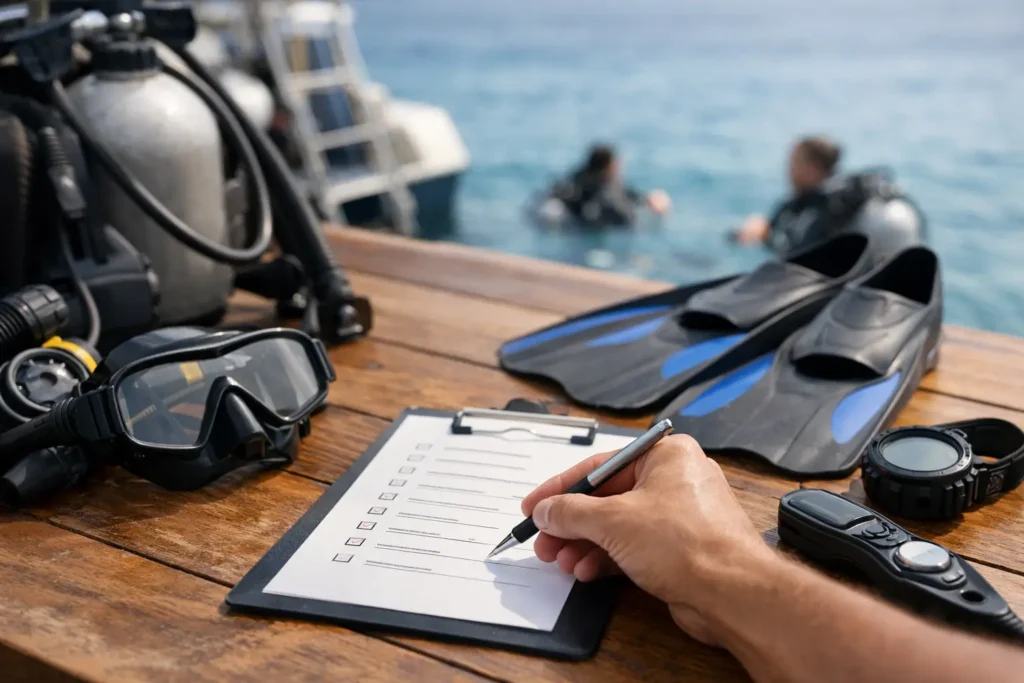
That last-minute scramble in the parking lot is usually where a dive day starts going sideways. A missing weight belt, a buddy who assumed a different entry, or water that looked decent online but turns out green and blown out in person – all of it costs time, money, and sometimes the whole session. A solid before you go diving checklist fixes that by forcing the right decisions before the tanks are loaded or the fins hit the sand.
This is not just about remembering gear. It is about timing, visibility, safety, and whether the dive is worth making at all. If you want fewer wasted coastal runs and more sessions that actually line up, the checklist needs to start before you leave home.
What a before you go diving checklist should actually do
A useful checklist is not a random list of gear you copied once and never updated. It should help you answer three questions fast. Are conditions good enough to justify the trip? Are you and your buddy ready for the plan you chose? And if something changes at the site, do you have enough margin to adapt or walk away?
That means your checklist has to cover more than equipment. It should include visibility expectations, wind and swell trend, tide timing, access logistics, buddy coordination, and your own readiness. For scuba, that may also mean tank pressure, weights, and dive objective. For freediving or snorkeling, it may lean harder on current, entry risk, and how clean the water looks through the morning window.
Start with conditions, not gear
Most bad dive days are decided before anyone opens a gear bin. Surface weather alone does not tell you what the water will look like underwater, and that is where many people waste time. A clean-looking beach can still have poor underwater clarity. A calm morning can hide leftover swell energy or a tide shift that turns a good window into a short one.
Your first check should be whether visibility is likely to be worth the trip. That means looking at the local mix of swell, wind direction, tide movement, and any recent reports from actual water users. If you can get photo-backed observations or same-day community check-ins, even better. That kind of information is far more useful than a broad marine forecast when your goal is to see underwater, not just avoid rain.
It also helps to think in windows, not whole days. Some spots clean up for two hours around slack tide and then fall apart. Others are best early before wind builds. If your plan is flexible, that timing matters more than a generic forecast label like fair or moderate.
Build your go or no-go call before you load the car
A smart before you go diving checklist includes a decision point. Not a vague maybe. A real threshold.
Ask yourself what your minimum acceptable conditions are for this session. If you are doing a casual reef dive, maybe you want moderate current and enough visibility to stay oriented. If you are introducing a newer buddy to shore diving, your threshold should be stricter. Cleaner water, easier entry, lower surge, shorter swim. If you are highly experienced and diving a familiar site, you might tolerate more movement or shorter visibility.
The key is honesty. People tend to stretch the call once they have already packed, driven, and texted the group. That is exactly why the decision criteria should be made early. Stop guessing once the signs point to a bad window.
Gear check: simple, fast, and specific
Once conditions justify the trip, then gear matters. This is where many checklists get too long and become useless. You do not need a dramatic spreadsheet for a local shore dive. You need a repeatable system that catches the stuff that ruins sessions.
For scuba, verify the obvious first: mask, fins, exposure suit, BCD, regulator, weights, tank, computer, and surface marker if the site requires one. Then check the less obvious things people forget under time pressure: are your tanks filled, is your computer charged, did you pack the right thermal protection for the actual water temperature, and do you have the entry gear you need for the specific site, not just any site?
For freediving and snorkeling, keep the same mindset. Mask and fins are obvious. A low-volume mask that seals, a suit that matches the temp, a float if appropriate, hydration, and site-specific safety gear matter just as much. If visibility is expected to be mediocre, a bright float or stronger surface signaling setup can make more sense than usual.
This is also the moment to check fit and condition, not just presence. A frayed fin strap, sticky inflator, torn snorkel keeper, or nearly dead light battery is easy to ignore at home and annoying in the water. If one small issue could shorten the session, deal with it now.
Your buddy plan should be boringly clear
A lot of dive problems start with assumptions. You thought your buddy knew the entry point. They thought you were doing a shorter route. You expected a strict one-up, one-down rhythm. They expected a looser session. None of that belongs in the water.
Before leaving, confirm who is going, where you are meeting, what the primary site is, and what the backup is if conditions disappoint. Agree on the rough schedule and the actual objective. Are you scouting, training, shooting photos, or just trying to get a clean hour in? Different goals change pace, depth, bottom time, and positioning.
If you are shore diving, talk through entry and exit, current expectations, and what would trigger an early call. If you are boating, clarify boarding time, max dive count, reserve pressure, and whether conditions support the original plan. The best buddy plans feel almost overexplained on land, which is exactly why they work in the water.
Check yourself, not just the ocean
One part of any before you go diving checklist gets skipped because it is less fun: your own readiness. Did you sleep enough? Are you hydrated? Are you carrying fatigue from travel, work, training, or yesterday’s session? Did you eat something useful, or are you planning to run on coffee and momentum?
This matters more than people admit. Marginal conditions feel very different when you are rested versus foggy. Cold hits harder when you are under-fueled. Decision-making gets sloppy when you are rushing. If the session already depends on a narrow weather or visibility window, your personal margin needs to be better, not worse.
This is especially true on trip days. Travel divers often overcommit because they have limited time and want to force a session. But unfamiliar entries, local current patterns, and shifting visibility are exactly where ego turns expensive quickly.
Site details make or break local dives
A generic checklist misses local friction. Parking rules, long walks to entry, tide-dependent rock access, surf exposure, boat traffic, and cell service all affect the session. The ocean may be fine while the site is still a bad choice.
So add a short site-specific layer. How far is the carry? Do you need cash for parking or entry? Is there a safer alternate exit if surge builds? Does the area get crowded at certain times? Are there marine life considerations, local advisories, or visibility patterns that tend to follow wind shifts?
This is where a coastal planning tool can save serious time. Instead of stitching together forecasts, crowd reports, and tide guesses from five places, you want one read on likely water clarity and the best time window. For divers and snorkelers, that is often the difference between a quick confidence check and a wasted morning.
The night-before version is different from the morning-of version
Treat these as two separate checklists. The night before, you are screening the plan. Confirm conditions trend, prep gear, charge devices, coordinate with your buddy, and identify the backup option. This step should remove uncertainty, not create it.
The morning of, you are validating the call. Recheck the latest reports, compare them to the trend you expected, and ask whether the window still holds. If visibility slipped, wind swung onshore, or your buddy bailed, the plan changed. Adjust early.
This is also the right time to avoid commitment bias. Just because the plan looked good last night does not mean it is still the right call at sunrise. Smart ocean users change plans all the time. That is not flaking. That is how good sessions happen.
A checklist only works if it stays realistic
If your checklist takes 20 minutes to read, you will stop using it. Keep it practical. Conditions, timing, gear, buddy, self, site. That is the core. Add specifics based on your discipline and your local coast, but do not turn it into paperwork.
A good system should help you move faster because it cuts second-guessing. It should also help you bail faster when the signs are wrong. That is part of the value. Better planning is not just about getting in the water more often. It is about getting in when conditions line up.
If you want one habit that improves almost every ocean session, make it this: do the check before the drive, not at the shoreline. The water will still surprise you sometimes. But a sharp, honest checklist gives you a much better shot at showing up on the right day, at the right time, for the right kind of dive.