
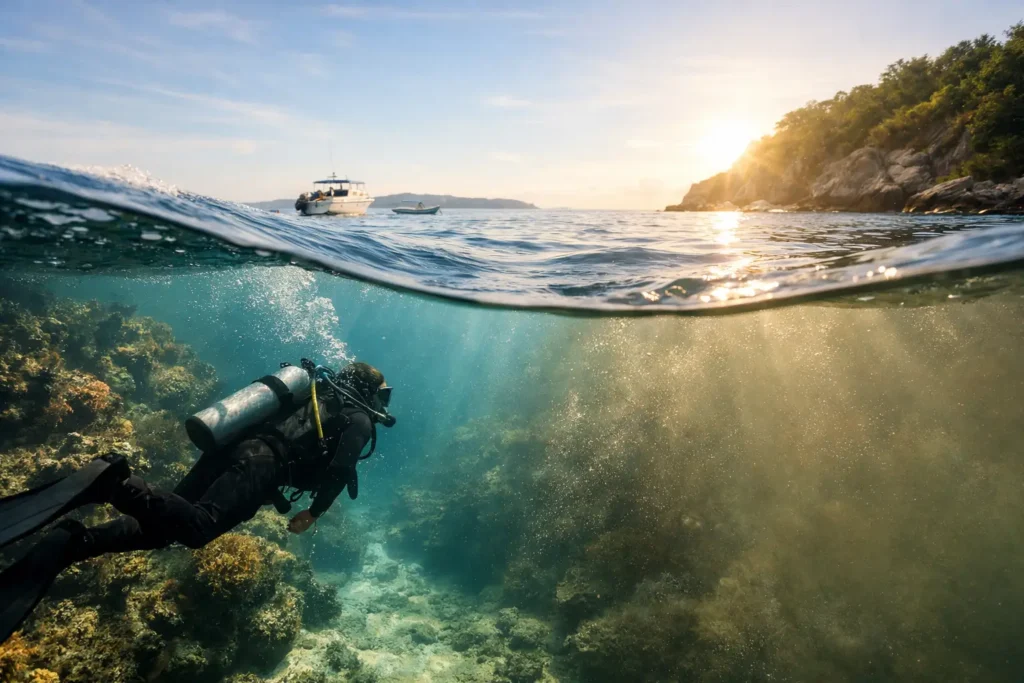
You can show up to the same reef two hours apart and feel like you’re diving a different spot. The swell might look unchanged from shore, the wind may still be light, and yet underwater visibility, current, and entry safety can shift fast. That’s why understanding dive conditions by tide matters so much for divers, snorkelers, and freedivers trying to get in when conditions line up instead of burning gas, time, and daylight on a bad window.
Tide is one of the most misunderstood parts of session planning because it rarely works alone. A tide chart tells you water level and timing. It does not tell you how that water movement will affect clarity at your exact cove, reef, harbor mouth, or jetty. The useful question is not just whether it’s high or low tide. It’s what the changing tide is doing to the spot.
Why dive conditions by tide are so site-specific
The same incoming tide that cleans up one location can trash another. If a site opens to clear offshore water, a rising tide may push cleaner water across the reef and improve visibility. If that same site sits near a river mouth, marina, lagoon outlet, or muddy channel, the tide can pull in suspended sediment, runoff, or plankton-rich water and make things worse.
Bottom type matters too. Sand, silt, cobble, and reef all react differently when water starts moving. A sandy entry can stay manageable at slack tide and turn cloudy once the exchange speeds up. Rocky structure often holds better visibility, but only if surge and current stay reasonable. None of this is theoretical when you’re deciding whether to suit up or head home.
This is where divers get tripped up by simple rules like “high tide is always best” or “go on the outgoing.” Sometimes that works. Sometimes it absolutely does not. The real pattern comes from knowing how the tide interacts with local geography, recent weather, swell angle, and the way sediment moves at that spot.
What tide actually changes underwater
When people talk about dive conditions, they usually mean visibility first. Fair enough. If you can’t see, not much else feels great. But tide affects several parts of the session at once.
Visibility often changes because moving water either brings in cleaner ocean water or stirs up bottom material. An incoming tide can improve clarity where clean outside water floods over a reef. An outgoing tide can improve clarity in enclosed areas if it flushes cloudy water out. The direction matters less than the source of the water and what it passes over on the way.
Current is the next big factor. Around channels, points, passes, and inlets, the strongest current often builds between high and low tide rather than at the peak itself. That can turn an easy dive into a high-effort swim, especially for freedivers and snorkelers who planned for a mellow session. Slack tide, or the slower period around the turn, is often the easier choice when current is the main issue.
Entry and exit also shift with tide height. A low tide can expose rock shelves, tighten channels, and make surge more awkward at the shoreline. A higher tide may cover hazards and create an easier float-out, but it can also let waves break farther inland onto rocks that are dry at lower water. There’s no universal “safer tide.” There’s only safer for that break, that ledge, that cove, on that day.
Marine life changes with tide too. Some fish and invertebrates feed more actively on moving water. Certain sites come alive around tide exchanges. Others feel dead until the current slows. If your goal is photography, bug hunting where legal, or simply a relaxed sightseeing dive, the best tidal window may be different than it is for advanced drift-style movement.
Incoming vs outgoing tide
Incoming tide gets recommended a lot, and sometimes for good reason. At many open-coast reefs, it can bring in cleaner bluewater and improve visibility after a windy day or small swell event. If the area inside the reef is shallow and sandy, the first part of the incoming may still be mixed, while the middle to later stage cleans up. That pattern is common, but not guaranteed.
Outgoing tide can be excellent at spots where the water inside a bay or harbor settles and clears between exchanges, then drains with decent visibility. It can also be the worst possible window if runoff, boat traffic, or stirred-up sediment gets pulled past your dive site on the ebb.
The mistake is treating incoming and outgoing as quality labels. They’re just directions of water movement. What matters is where that water came from, what it traveled over, and how fast it’s moving when you’re in it.
High tide, low tide, and slack water
High tide and low tide describe water level, not necessarily the best dive moment. Many divers do best around slack water because current eases and the site becomes more predictable. That’s especially useful near inlets, cuts, and narrow reef passages where moving water can accelerate fast.
But slack tide is not a magic window either. On some beaches, the cleanest water arrives an hour before high or low, not right at it. At others, the water level at high tide makes the entry safer even if the visibility peaked earlier. The best plan often balances three things at once: underwater clarity, current strength, and how clean the entry and exit will be.
If you only optimize one of those, you can still lose the day. Great visibility is not worth much if the exit is sketchy. Easy entry is not enough if current makes the site a workout. This is why practical planning beats chasing a single tide number.
How to read dive conditions by tide without overcomplicating it
Start with the location type. Is it an exposed reef, protected cove, harbor edge, river mouth, kelp bed, jetty, or channel? Each one responds differently. Then look at recent wind and swell. If the spot has already been stirred up, the “good tide” may not save it. If conditions have been calm for a day or two, the cleaner window may be more obvious.
Next, compare the tide stage with what usually drives problems there. If your issue is sediment getting lifted off a sandy bottom, stronger water movement may be the enemy. If your issue is stale or trapped water in an enclosed area, some exchange may help. If current is the main risk, you’re probably looking for a slower period near the turn.
Local observations matter more than broad rules. The fastest way to learn a site is to log what you actually saw at different tides. Note the entry, visibility, current, and whether the water looked cleaner outside or inside the break. After a few sessions, patterns start showing up. This is exactly why a coastal planning tool that combines environmental data with real user reports is more useful than a generic tide chart alone. Searu is built for that kind of decision-making – fewer guesses, better timing.
Common mistakes divers make with tide timing
One common mistake is arriving right at high or low tide without accounting for when the conditions actually improve. Tidal influence often lags. The chart says one thing, but the water at your site may respond earlier or later depending on distance from open ocean and the shape of the coastline.
Another mistake is ignoring tide range. A small tidal swing may create gentle movement and minimal change. A larger exchange can amplify current, surge, and sediment transport. The same spot that’s easy on a mild tidal day can become noticeably more dynamic during a bigger one.
Divers also underestimate the effect of combining tide with swell. A favorable tide can still produce poor visibility if swell is hitting the entry at the wrong angle or churning a shallow sand channel. Tide can help or hurt, but it rarely overrides bad energy in the water.
Finally, too many people plan around visibility only. If you’re solo, unfamiliar with the site, or trying to fit a quick session before work, easy and safe often beats perfect. There’s a big difference between a clean dive and a clean dive you can actually enter and exit without stress.
The smarter way to time your session
Think in windows, not single moments. Instead of asking, “Is high tide good here?” ask, “What two-hour window gives me the best mix of visibility, current, and entry?” That framing is much more useful in the real world.
For many nearshore dives, the sweet spot ends up being just before or after the turn, when one factor is improving and another hasn’t become a problem yet. Maybe the water is cleaner on the first half of the incoming, but current gets pushy later. Maybe low tide exposes the rocks too much, so you aim for the rise. The best call is usually a compromise made on purpose.
That’s also why community check-ins are so valuable. Tide tables are fixed. Actual conditions are not. If someone at your exact coastline saw murk on the outgoing or clean water starting an hour before high, that can save you from rolling the dice.
The goal isn’t to memorize every tidal rule. It’s to build a simple habit: check the tide, check the wind and swell, look for recent local observations, and match your session to the window that gives you the highest odds of good water and a clean exit. Stop guessing, and the ocean gets a lot more cooperative.