
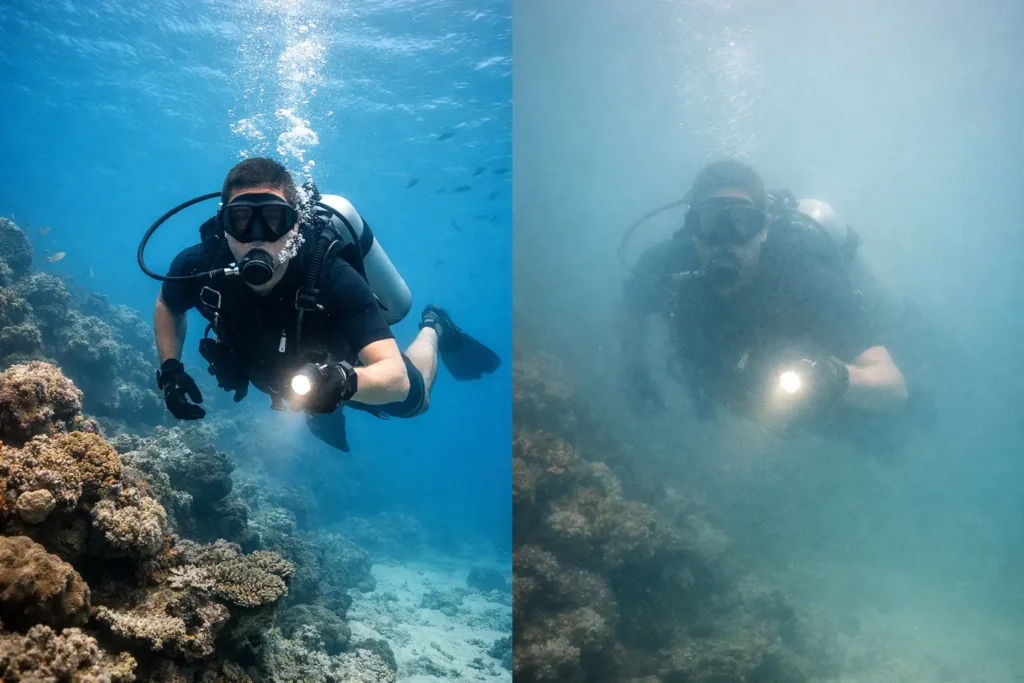
You can have a full tank, a free morning, and a buddy ready to go – and still lose the day to six feet of murk. That is why a scuba visibility report matters. For most divers, the hard part is not deciding whether to dive. It is figuring out whether the water will actually be worth the drive, the prep, and the risk.
Generic weather apps do not solve that problem. They can tell you wind speed, surf height, and maybe tide timing, but they do not answer the question scuba divers care about most before leaving home: Will I be able to see anything down there?
What a scuba visibility report should tell you
A useful scuba visibility report is not just a number. If someone says visibility is 15 feet, that might sound decent to one diver and barely worth it to another. Context matters. Shore entry divers, photographers, students, bug hunters, and spearfishers all read the same number differently.
The best reports combine the visibility estimate with timing, recent changes, and local texture. Was that 15 feet at slack tide or during a dropping tide? Was it protected cove visibility or open-coast visibility? Did it hold through the session, or did the water turn after the wind shifted? Those details are the difference between a quick guess and a real planning tool.
A good report also helps you think in windows instead of all-day averages. Conditions that are bad at noon can be clean at first light. Water that looks blown out on the surface can still settle underwater in a protected zone. The point is not to chase certainty. It is to get closer to the right call before you load the car.
Why visibility is so hard to predict
Visibility feels simple when you are in the water. You can see well, or you cannot. Predicting it ahead of time is where things get messy.
Wind is one factor, but not the only one. Strong onshore wind can stir up sand and reduce clarity near shore. Offshore wind may clean up the surface while swell energy still keeps the bottom moving. A small swell period can create one kind of chop, while a longer-period swell can move much more water and suspend much more sediment, even if wave height does not look dramatic on a forecast.
Tides complicate things further. In some spots, incoming tide brings cleaner ocean water. In others, tide movement pulls runoff, sand, or harbor water into the zone you want to dive. Then there is recent weather. Rain from yesterday, not just this morning, can shape what you find today. River mouths, reefs, kelp beds, jetties, and sandy bottoms all react differently.
That is why a true scuba visibility report has to be more than a single forecast layer. It has to translate multiple variables into a practical answer for a specific area and a specific time.
The problem with relying on one source
A lot of divers still build their own patchwork forecast. They check marine weather, surf cams, tide charts, buoy readings, maybe a local social post, then try to stitch it all together. That can work if you know the spot extremely well and have time to compare everything. Most people do not.
The bigger problem is that raw data does not always map cleanly to underwater clarity. Two days with similar wind and swell numbers can produce very different visibility. Local geography changes everything. So does recent history. If a spot has been churned up for three straight days, one calm morning may not fix it.
This is where community input matters. Real check-ins from people who were actually in the water can correct the blind spots in model-based forecasts. Photos help too, especially when they are tied to time and place. But community reports alone are not enough either. They are snapshots, not outlooks. If you only know what it looked like three hours ago, you still have to guess what it will do by the time you arrive.
The strongest approach blends both. You want observed reality plus forecast intelligence. One tells you what happened. The other helps you judge what happens next.
How to read a scuba visibility report without overtrusting it
Even a strong report is still a decision aid, not a promise. Ocean conditions shift fast, and visibility is one of the most local, fragile parts of the equation.
Start by looking at the trend, not just the headline. Improving visibility with calming wind and easing swell usually means your odds are getting better. Good visibility with worsening onshore wind can be a short-lived gift. The number matters, but the direction matters more.
Then look at the timing. If the report suggests a clean morning window and a dirtier afternoon, treat that seriously. Many wasted dive days happen because people read a decent all-day outlook and miss the fact that the best conditions were only there for two hours.
You should also read the report through your dive objective. If you are teaching a new diver, you may want more margin than you would for a casual bug dive at a familiar site. If you are doing underwater photography, average visibility may still be disappointing if the water has a lot of particulate. If the goal is simply to get wet and stay sharp, your threshold can be lower.
A report should help you match the session to the conditions instead of forcing conditions to match the session you wanted.
What makes a report actually useful for real-world dive planning
The best scuba visibility report does three things fast. It saves time, reduces bad calls, and helps you choose a better window.
Saving time matters more than people admit. Every diver knows the routine: charging lights, loading weights, coordinating a buddy, driving an hour, then standing on the shore staring at brown water. That is not just frustrating. It burns fuel, free time, and motivation. If a report helps you rule out a bad call before the trip starts, that is real value.
Reducing bad calls matters because poor visibility is not only disappointing. It can make navigation harder, increase stress, separate buddies, and turn a simple shore dive into a much sloppier session. Visibility is not the only safety variable, but it touches a lot of others.
Timing is where the biggest gains show up. Many divers are not looking for perfect conditions. They are looking for the best available window. A practical report helps you spot that window before everyone else is texting the group chat asking if it is worth it.
That is also why surface-only forecasts fall short. Divers do not need more data for data’s sake. They need translation. One place where Searu stands out is that it focuses on turning wind, tide, swell, and local observations into a visibility-centered read instead of making you do all the interpretation yourself.
Why local reports still beat broad forecasts
If you dive the same coastline enough, you learn that a few miles can completely change the day. One cove is green and clear. The next entry is churned up and useless. A broad regional forecast cannot capture that level of detail well.
Local reporting closes the gap. Community check-ins, timestamped observations, and spot-aware condition reads are what make a visibility tool feel trustworthy. They reflect how the coast actually behaves, not how a generic map layer averages it out.
This is especially valuable for traveling divers and newer locals. Experienced regulars may know that a certain beach handles west swell better or that a harbor side cleans up on a certain tide. Visitors usually do not. A good report shortens that learning curve without pretending every spot behaves the same.
The trade-off every diver should remember
More information does not always mean a better decision. If you are bouncing between five apps, three cameras, and two text threads, you can still end up uncertain. Sometimes even more uncertain.
The trade-off is simple. Raw data gives you detail but asks you to do the interpretation. A visibility-focused report gives you speed and usability but depends on good inputs and smart modeling. The right choice for most divers is not one or the other. It is a system that filters the complexity down to something actionable while still leaving room for your own judgment.
That is the sweet spot. Not guessing blindly, and not overcomplicating a go or no-go call.
A scuba visibility report is most useful when it helps you feel confident enough to act, cautious enough to adapt, and smart enough to wait when the window is not there yet. The ocean is not going anywhere. Better to get in when conditions line up.