
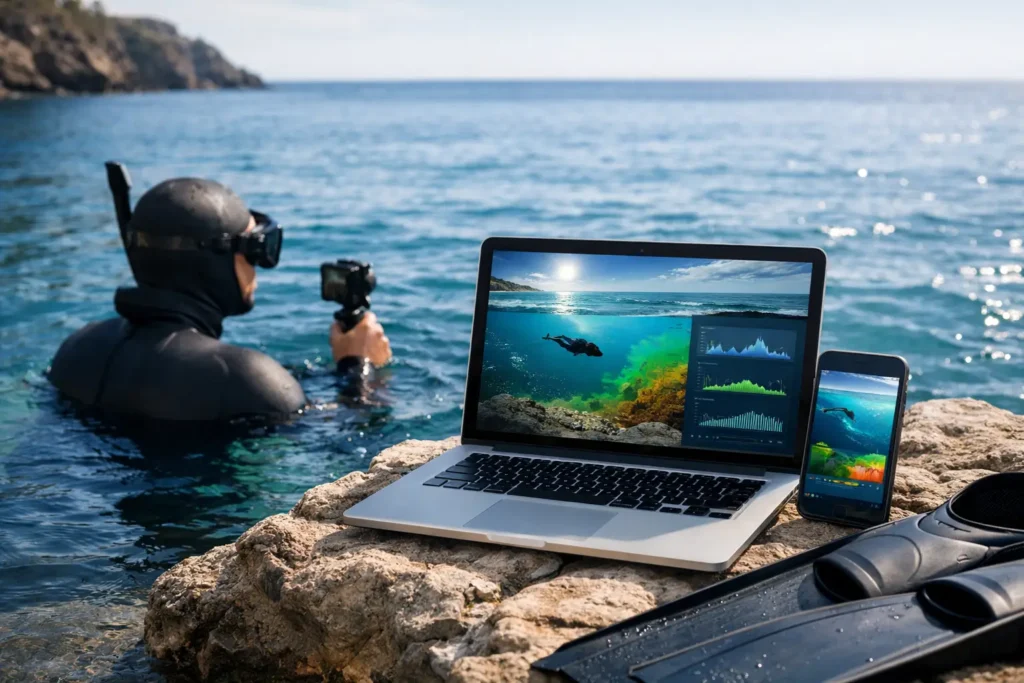
You can have perfect breath-hold, dialed gear, and a full tank of motivation – then show up to green water and call it before your first duck dive. That is exactly why freediving visibility forecast tools matter. For freedivers, visibility is not a nice-to-have. It shapes safety, comfort, hunting, photography, line diving, and whether the session is worth the drive at all.
Generic weather apps do not solve this. They tell you what the wind is doing, maybe the swell, maybe the tide. But they rarely answer the real question: will the water actually be clear enough to get in? That gap is where visibility-focused planning tools earn their place.
What freediving visibility forecast tools actually do
The best freediving visibility forecast tools take messy environmental inputs and turn them into a simple call you can use. Instead of asking you to interpret five charts and three marine forecasts on your own, they translate conditions into a visibility outlook and a better sense of timing.
That distinction matters. Ocean clarity is not controlled by one variable. Wind can stir up sediment. Swell can churn shallow reefs and shore entries. Tide can improve or wreck a spot depending on local geography. Recent rain can dump runoff into a cove that looked fine on a standard forecast. A tool built for visibility tries to connect those moving parts into something practical.
For a freediver, practical usually means three things: Is it worth going, when is the best window, and how confident should I feel about what I will find?
Why standard forecasts fall short for freedivers
Most marine forecasts are built for surface users first. That is useful, but incomplete. A calm-looking morning on the surface does not always mean clean water below. Likewise, a spot with moderate wind might still hold decent visibility if swell direction, tidal movement, and bottom type line up in your favor.
Freedivers tend to learn this the expensive way. You check a few weather sources, make the drive, gear up, and realize the conditions were technically manageable but underwater visibility is still poor. The problem was never a lack of data. It was a lack of translation.
Freediving visibility forecast tools are useful because they focus on the decision you actually need to make. They narrow the gap between raw environmental data and the real experience in the water.
The inputs that matter most
A good visibility forecast is only as good as the signals behind it. Wind, swell, tide, and recent weather are the obvious ones, but what matters is how they combine at a specific site.
Wind and chop
Onshore wind often hurts visibility faster than people expect, especially at exposed beach entries and shallow reefs. It can create surface chop, push suspended sediment around, and make spotting structure or your buddy harder even before subsurface clarity fully falls apart. Offshore or light wind can improve the window, but only if swell and local bathymetry cooperate.
Swell size and direction
Swell is one of the biggest visibility wreckers in many coastal zones. Large swell can stir sand from the bottom and keep it suspended long after the set energy looks manageable from shore. Direction matters too. Some coves stay protected under one swell angle and turn cloudy under another.
This is where local context matters more than raw numbers. A six-foot swell is not universally bad or universally fine. It depends on the spot.
Tide movement
Tide can work for or against visibility. In some areas, incoming tide brings cleaner ocean water. In others, outgoing tide drains murk, runoff, or harbor influence into the exact area you planned to dive. Slack periods can be cleaner and easier for line work, but not always. Anyone who regularly dives one coastline learns there is no universal rule.
Rain and runoff
Rain is often underestimated by visiting divers. A forecast may look decent after a storm passes, but runoff can keep nearshore visibility poor for a day or more depending on watershed size, surf exposure, and water circulation. If a tool ignores recent precipitation, it can miss one of the biggest reasons a session goes sideways.
What to look for in freediving visibility forecast tools
Not every tool with ocean data is a real visibility planning tool. If you are trying to save time and avoid bad calls, the best setups usually include a few key layers.
First, look for simplified visibility guidance rather than raw charts alone. You should not have to be your own marine analyst every time you want a quick shore dive.
Second, look for location-specific interpretation. Regional forecasts are useful, but freediving spots are hyper-local. The difference between a protected cove and an open beach can be huge even within a few miles.
Third, look for time windows, not just daily labels. Conditions often shift over a few hours. Early morning can be cleaner before wind builds. An incoming tide may improve a cove for a short stretch. Good tools help you time the session, not just approve or reject the day.
Fourth, community observations matter. Real photos, fresh reports, and check-ins help validate the forecast against what people are actually seeing. Forecasting visibility is hard because the ocean is local and messy. Recent user input helps close that gap.
Finally, safety features are not extra. They belong in the same workflow. If you are deciding whether to dive, it helps to know not just if the water may be clear, but also whether you have a buddy lined up and whether people are actively checking in nearby.
Forecasts are useful, but confidence comes from layering
The smartest freedivers do not rely on one number or one source. They stack signals. A visibility forecast gives you the starting point. Then you look at local reports, recent photos, spot exposure, and your own history with that coastline.
That is not a knock on forecasting. It is just honest. Visibility is one of the hardest conditions to call perfectly because sediment, runoff, current, and local bottom structure can change fast. The goal is not certainty. The goal is better odds, fewer wasted trips, and safer calls.
This is also why tools that blend forecast data with real user observations tend to be more useful than weather-only products. They are closer to how experienced water people already think.
How freedivers should use these tools before a session
The best approach is fast and repeatable. Check the visibility outlook first. If the day looks promising, look at the suggested timing window. Then sanity-check it against recent reports and what you know about the spot.
If the signal is mixed, that does not always mean cancel. It might mean changing the entry, shifting to a more protected site, or shortening the mission. Some days are still worth it for training, shallow work, or scouting, even if they are not ideal for photography or deeper hunting.
If the tool is showing poor clarity and local reports agree, believe it. This is where people burn time. They talk themselves into a marginal mission because the surface looks clean or because they already packed the car. Better planning is not just about finding good sessions. It is about avoiding bad ones early.
Where specialized tools have the edge
This is where a platform like Searu fits naturally. Instead of forcing you to stitch together tide charts, wind forecasts, swell models, and scattered local comments, it centers the actual question coastal users care about – when water visibility and conditions line up well enough to go. That blend of forecast interpretation, local observations, timing windows, and buddy coordination is much closer to how freedivers make real decisions.
The edge is not just convenience. It is clarity. When a tool is designed around underwater conditions instead of generic marine weather, you spend less time decoding inputs and more time deciding whether the session makes sense.
The trade-off every freediver should understand
No visibility tool is magic. If a coastline is highly dynamic, a forecast can be directionally right and still miss the exact conditions at your entry by a few feet of clarity. That is normal. The ocean does not care about app precision.
What matters is whether the tool improves your hit rate over time. Does it help you avoid obvious no-go windows? Does it surface better timing you might have missed? Does it give you enough confidence to leave earlier, switch spots, or skip a bad mission? That is the standard worth using.
Freedivers do not need more data for the sake of data. They need faster, cleaner decisions backed by signals that reflect what actually happens underwater. The right forecast tool will not replace local knowledge, but it will sharpen it and make each session easier to plan.
If you are tired of guessing, start treating visibility like the first filter instead of the last surprise. The best ocean days usually do not happen by accident.