
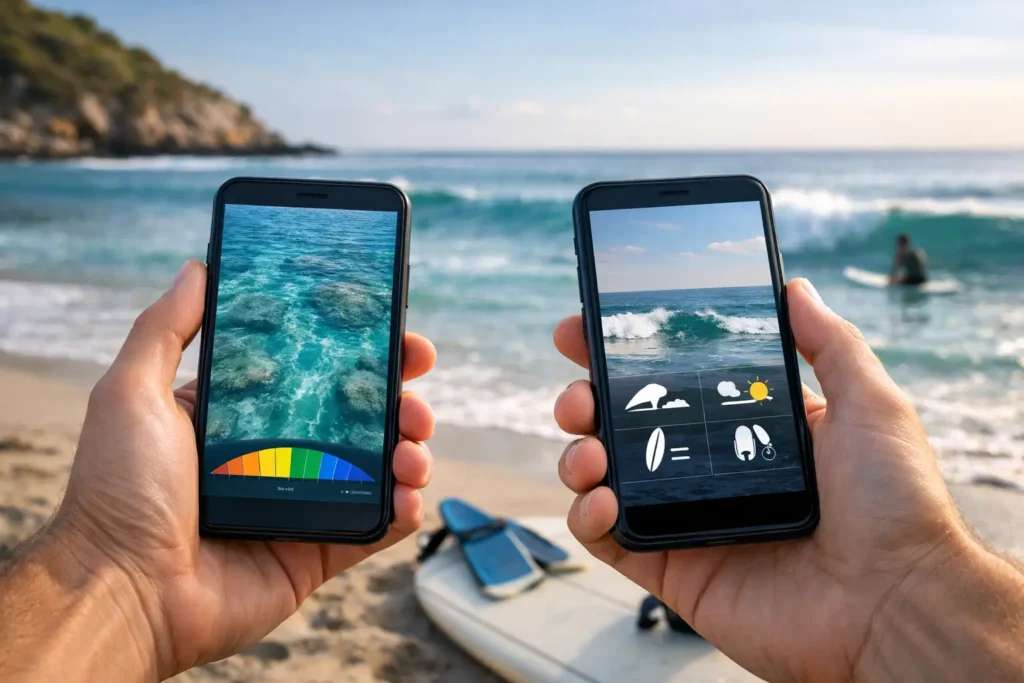
A clarity app versus surf report is not really a fight over which forecast is better. It is a question of what you need to know before you load the car, fill the tank, prep your gear, and commit to getting in the water. If you are chasing waves, a surf report can tell you plenty. If you are trying to see below the surface, it may leave out the answer that matters most.
A chest-high, clean-looking wave forecast does not guarantee a good freedive. Light wind does not automatically mean clear water. And a flat morning can still deliver milky visibility after runoff, shifting sand, or a few days of mixed swell. Stop guessing from one surface-level number. The right tool depends on the session you are planning.
What a surf report is built to answer
Surf reports are designed around the experience of riding waves. Their main job is to help surfers judge whether a break is worth checking: wave height, swell direction and period, wind direction and speed, tide, and sometimes crowd or spot notes.
That information is valuable, even if you never stand on a board. Swell and wind affect nearly every nearshore ocean session. A long-period south swell can move more water than a forecasted wave height suggests. Offshore wind may groom the surface while a larger swell still stirs up sand along the bottom. Tide can change entry conditions, current, and how a reef or sandbar behaves.
For surfers, that is the point. They are reading the shape, energy, and consistency of the waves. The report is usually answering, “Will this break work?” It is not primarily answering, “Can I see five, 15, or 30 feet underwater?”
That distinction matters when your plan involves snorkeling, scuba, freediving, spearfishing, swimming, or simply finding a beach where the water looks inviting instead of brown.
Why surface conditions do not equal visibility
Water clarity is the result of multiple variables acting together, often on different timelines. Wind can rough up the surface within hours. Swell can stir sand and sediment near shore. Rain can send runoff through channels and outfalls. Strong tides can move murky water through an inlet, while local geography can keep a protected cove clear nearby.
A surf report gives you some of the ingredients, but you still have to interpret the recipe. That is difficult when you are checking several sites at night, trying to coordinate a buddy, or deciding whether an early alarm is actually worth it.
Consider two mornings with the same forecast: two-foot surf, light wind, and a rising tide. One might offer clean blue water after several calm, dry days. The other could be silty from recent rain and lingering swell that churned the bottom overnight. On paper, the surface conditions look similar. Underwater, they are completely different sessions.
This is why divers often rely on local group chats, beach cameras, recent photos, harbor readings, and friends who were just in the water. Those sources can be useful, but they are fragmented and quickly become stale. A photo from yesterday afternoon does not always represent first light today.
Clarity app versus surf report: the practical difference
The practical difference is the decision each tool helps you make. A surf report helps you judge wave quality and exposure. A clarity-focused app helps you judge visibility and identifies the windows when conditions are more likely to line up for getting in.
A good clarity outlook translates raw marine variables into a simple, session-specific read. Instead of expecting you to calculate whether wind, tide, swell, rain, and local observations will create clear water, it gives you a usable answer: conditions are improving, visibility is questionable, or a certain time window has better potential.
That does not make a clarity app a replacement for ocean judgment. No forecast can see every current, submerged hazard, boat traffic pattern, or change at your exact entry point. But it can reduce the gap between a broad weather forecast and the real question you have at 6 a.m.: should I go now, wait until later, or choose another spot?
For many ocean users, the best setup is not one tool or the other. It is using a surf report to understand wave energy and exposure, then using a clarity app to assess whether those conditions are likely to produce a worthwhile underwater session.
When a surf report is enough
There are days when a standard surf report does most of what you need. If you are surfing a familiar break, wave height, period, wind, and tide may be your whole decision framework. You can see the ocean from home, know the local sandbars, and have enough experience to fill in the missing details.
A surf report can also be enough for a casual beach day when underwater visibility is not the priority. If the goal is a walk, a shoreline workout, or a quick look at the waves, you may not need specialized clarity guidance.
It also depends on the coastline. In a location with consistently clear water, limited runoff, and a simple bottom contour, visibility may be more predictable. In a river-influenced beach, a shallow sandy bay, or an area exposed to regular swell, small changes can make a major difference. That is where generalized reports become less decisive.
When clarity guidance changes the plan
Visibility becomes a core safety and value factor when your session depends on what is below the surface. A freediver needs to see the bottom, manage depth awareness, and stay connected with a buddy. A snorkeler wants to know whether the reef is likely to be visible before driving an hour with kids and gear. A scuba diver may need a realistic read on entry conditions and whether the dive will deliver enough visibility to justify the effort.
Poor clarity is not just disappointing. It can make navigation harder, separate buddies, hide hazards, and change how comfortable a new or visiting ocean user feels in the water. Conditions that are manageable for an experienced local may be a clear no-go for someone unfamiliar with the site.
A clarity app earns its place by bringing together the signals that affect this decision: current and recent conditions, environmental factors, predicted timing, local images, and reports from people who have actually been there. Searu applies that approach with AI analysis, community check-ins, and suggested windows, so users can spend less time assembling clues and more time choosing a smart plan.
The community component matters because the ocean is local. A regional forecast may say conditions are fair, while someone at your intended beach can report a dirty shoreline, a clear pocket near the rocks, or a strong current at the usual entry. That kind of current context helps turn a forecast into an informed decision.
Read the forecast in the order that protects your time
Start with the purpose of the session. If you are surfing, inspect swell, period, wind, tide, and the break’s preferred direction. If you are planning to be underwater, begin with expected clarity and then check the forces behind it: recent rain, wind, swell, tide movement, and local reports.
Next, look for timing rather than treating the whole day as one condition. Early morning may be calmer before wind builds. A tide change may improve or worsen an inlet. A swell can fade enough by afternoon to let sediment settle. The useful question is rarely, “Is today good?” It is, “When is the best window, and is it good enough for my experience level?”
Then make the call with your buddy plan in mind. If visibility is uncertain, agree on conservative boundaries before you arrive. Choose a familiar site, stay closer than usual, use clear hand signals, or save the deeper objective for another day. If conditions do not line up, changing the plan is not a wasted trip. It is a smart ocean day.
Make the forecast serve the session
A surf report remains a powerful tool for reading what is happening on the surface. But underwater users need more than a wave score. They need a clearer view of visibility, timing, and the local conditions that determine whether a session will be fun, productive, and within their margin of safety.
Before the next drive to the coast, ask one extra question: not just whether the ocean will look good from shore, but whether it will work for what you plan to do once you are in it. That small shift can save a tank of gas, a missed morning, and a lot of murky-water frustration.