
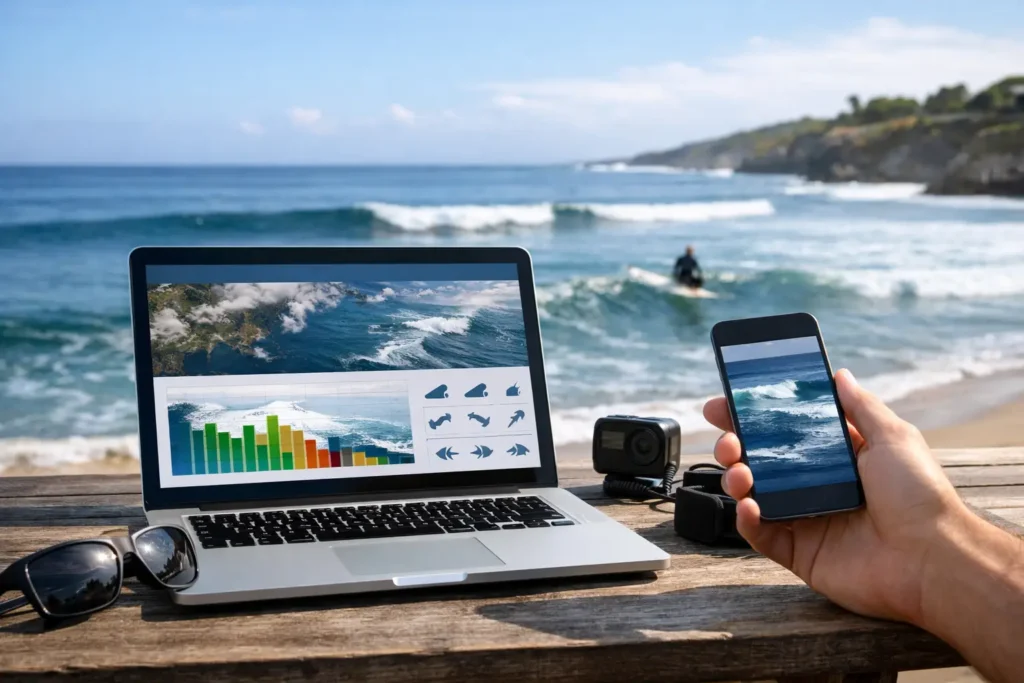
You do not need another forecast that says the ocean is “good” while the water looks like tea when you arrive. A useful daily ocean report review should answer the question that actually matters before you load tanks, wax gear, or text your buddy: will the water be worth it, and when?
That sounds simple, but it rarely is. Most ocean users still piece together surf cams, tide charts, wind apps, swell models, local group posts, and whatever a friend saw six hours ago. By the time you feel confident enough to commit, the window has shifted or the session is already burned. For divers, snorkelers, freedivers, and anyone who cares about visibility, the problem is not a lack of data. It is too much data with not enough translation.
What a daily ocean report review should actually tell you
A strong report does more than describe conditions. It helps you make a go or no-go call fast. That means it should translate raw inputs into practical outcomes like water clarity, entry comfort, current risk, and the best time window.
Wind speed alone does not tell you whether a cove will clean up by mid-morning. Tide movement alone does not tell you whether stirred-up sediment will settle before your planned entry. Swell direction may matter more than swell height at one spot, while runoff from a recent rain can ruin visibility at another even when surface conditions look tame. A report worth trusting connects those pieces instead of forcing you to do the math yourself.
This is where many generic marine forecasts fall short. They are built to show conditions, not interpret them for underwater users. Surfers may care most about wave shape and size. Boaters may care about sea state and wind. But if your whole day depends on seeing underwater, you need a different read on the same ocean.
Why a daily ocean report review matters more for visibility-based sessions
Visibility is the variable that changes everything. It affects whether a beginner can stay calm, whether a photographer gets usable shots, whether a spearfishing session is productive, and whether a scuba dive feels relaxing or frustrating. It also changes how safely people move in the water.
Poor visibility is not just disappointing. It can turn a planned session into a waste of fuel, time, and energy. For solo-prone activities like snorkeling at a quiet beach or freediving a less crowded spot, murky water can also increase stress fast. You may still technically be able to get in, but that does not mean it is a smart call.
That is why a daily review needs to focus on outcomes, not just measurements. Ocean users are not asking for a weather lecture. They want to know if there is a clean morning window before wind chop builds, whether the inside reef will stay stirred up on the incoming tide, or whether a protected backup spot makes more sense.
The inputs behind a good review
A useful report usually pulls from several moving parts at once. Wind matters because local onshore flow can break surface quality and churn sediment. Swell matters because long-period energy can wrap into places that look protected on paper. Tide matters because certain locations clear on slack water while others improve on a specific stage of the push or drop.
Then there are the variables that standard apps often underweight. Recent rainfall can reduce clarity near river mouths and urban runoff zones. Bottom type matters because sand gets kicked up differently than rock or reef. Local geography matters because a point, bay, harbor wall, or channel can change how all of the above behave at a specific site.
The best reports also include human observation. Real people in the water can confirm whether the model matched reality. A posted photo, a short note on surge, or a check-in about actual visibility can be more useful than another ten lines of raw forecast data. Data gives you direction. Community input gives you ground truth.
Daily ocean report review: what separates useful from noisy
The fastest way to judge a report is to ask whether it helps you decide. If it leaves you with more tabs open than when you started, it is probably noise.
A useful daily ocean report review should be clear about confidence. Some days are obvious. Light wind, small swell, no recent rain, and a known clean-tide window usually point to a straightforward call. Other days are mixed. Maybe the morning starts clean but a pulse of swell arrives by noon. Maybe one side of a coastline looks decent while exposed spots are blown out. Good reporting does not pretend every day is simple. It shows the trade-offs.
It should also be location-aware. “Coastwide fair conditions” is not enough if one cove is glassy and the next headland is surging. Ocean planning gets better when the report reflects how conditions break differently at local spots.
And it should save time. If you need 20 minutes to interpret a report, it is not doing enough work for you.
How to use a daily ocean report review before you commit
Start with your session goal, because not every user needs the same conditions. A casual snorkel with kids has a different threshold than a deep freedive training session. Underwater photography has a different tolerance for haze than a quick shore dive. If you know what kind of session you want, the report becomes easier to use.
Next, look for timing rather than a single all-day verdict. Many coast days are not good or bad from sunrise to sunset. They are good from 7 to 10, then chopped up after wind builds. Or they are poor at dawn, then improve as tide shifts and sediment settles. If the review gives you a usable window, that is often more valuable than a broad rating.
Then check whether forecast logic lines up with recent local observations. If users have reported murky inside conditions for two straight mornings after moderate swell, be careful about assuming today will magically clean up unless a real change has happened. Patterns matter.
Finally, make room for backup plans. The smartest ocean users are rarely locked into one exact entry point. They know their primary spot, their protected alternative, and their no-go threshold. A good report supports that style of planning instead of pushing a false sense of certainty.
Where traditional forecasts still help – and where they do not
Standard weather and marine apps are still useful. You need wind readings, tide timing, swell size, and radar context. The issue is not that those tools are bad. The issue is that they stop one step short of the decision.
If you are trying to figure out whether water clarity will be worth a 45-minute drive, generic tools often leave too much interpretation on your shoulders. They also tend to miss the session-level details that matter most to underwater users, like practical visibility outlooks, expected clean windows, and live reports from people who just got out.
That gap is exactly why specialized tools exist. Searu, for example, is built around the reality that ocean users do not just want conditions. They want clarity guidance, timing, local check-ins, and a faster path to a confident call.
The trade-off between speed and certainty
Every daily review balances speed and accuracy. If a tool tries to reduce the ocean to one oversimplified rating, it may be quick but misleading. If it dumps every variable on the screen without interpretation, it may be accurate but slow.
The sweet spot is a report that simplifies without pretending. It should tell you when confidence is high, when a spot is marginal, and when conditions depend on local knowledge or last-minute checks. That kind of honesty builds trust over time.
It also respects the fact that no model can fully replace the ocean in front of you. Conditions change. A harbor can plume out overnight. Wind can arrive early. A beach that looked promising on paper can still disappoint. A good review helps you stack the odds in your favor. It does not promise perfection.
What the best ocean users do differently
Experienced water people do not chase perfect forecasts. They build a better decision process. They know which variables matter most for their local spots. They pay attention to timing instead of broad daily labels. They compare forecast patterns with real-world check-ins. And they stay flexible enough to pivot when conditions miss the mark.
That is what makes a daily ocean report review valuable. Not because it removes uncertainty, but because it cuts down wasted guesses. When the tool is built around visibility, practical timing, and community-confirmed conditions, you spend less time sorting tabs and more time getting in when it lines up.
The ocean will always keep some cards hidden. Your job is not to predict every turn. It is to show up with a smarter read than you had yesterday.