
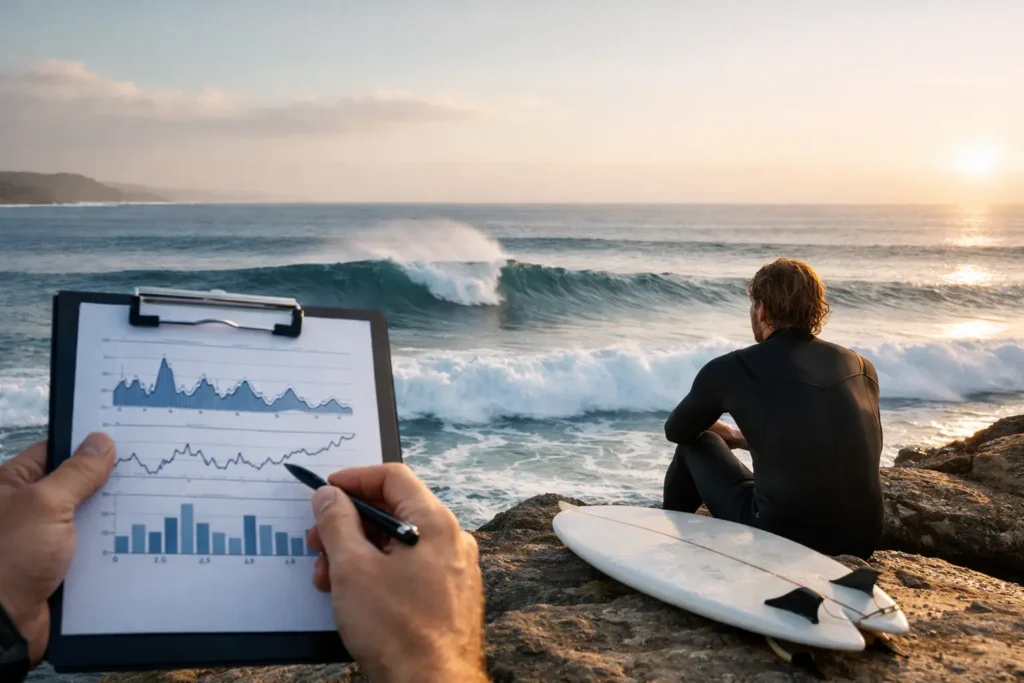
You check the forecast, see a small swell height, and think the water might be clean. Then you get to the coast and find surge, churn, and visibility that fell apart overnight. That gap is exactly why learning how to interpret swell periods matters. Wave height tells you how big it looks. Swell period tells you how much force is actually arriving.
If you snorkel, freedive, scuba dive, or spend time around nearshore structure, swell period can change your day fast. It affects surge in coves, how much sand gets stirred up, how hard entries and exits feel, and whether a spot that looked manageable on paper is actually worth gearing up for. You do not need to become a meteorologist. You just need to know what the number is really telling you.
What swell period actually means
Swell period is the time, in seconds, between waves in a swell train. If a forecast shows 8 seconds, that means one wave peak is followed by the next about 8 seconds later. If it shows 16 seconds, the waves are spaced much farther apart.
That spacing matters because longer-period swell usually carries more energy. Two swells can have the same height, but the one with the longer period often hits reefs, points, and shorelines with more power. For divers and snorkelers, that often means more surge, more bottom disturbance, and a better chance that visibility gets worse.
A simple way to think about it is this: short period swell is more like a constant slap. Long period swell is more like a heavier pulse. It may look more organized offshore, but when that energy reaches shallow water, it can move a lot more water than newer ocean users expect.
How to interpret swell periods in real conditions
The fastest read is to stop looking at swell period as an isolated number. Pair it with swell height, swell direction, local bathymetry, and your spot type.
An 8-second swell at 3 feet is usually a very different day than a 16-second swell at 3 feet. On paper, the height is identical. In the water, the longer period swell may wrap farther into your cove, create stronger surge near rocks and reefs, and stir up sediment that ruins visibility.
Direction changes the picture too. A long-period swell from a blocked direction might not do much at your spot. A moderate-period swell from the exact open angle of your coastline can create plenty of movement. This is where local knowledge matters. Period tells you how much energy is in the pulse. Direction tells you whether your breakwall, reef, bay, or beach is actually going to feel it.
Bottom shape matters just as much. Sandy beaches tend to get murkier faster when incoming energy stirs the bottom. Rocky coastlines can stay clearer in some setups, but surge may become the bigger issue. Protected coves can look calm at the surface while still surging underwater if longer-period energy is sneaking in.
A practical range for reading swell period
There is no universal rule that works for every coast, but these ranges are useful for quick planning.
Under 8 seconds usually points to shorter-period wind swell. That often means choppier surface texture and less organized energy. For visibility, this can go either way. If winds are light and the spot is protected, short-period swell may not do much damage. But if local wind is already roughing up the coast, short-period swell can add to the mess.
Around 9 to 11 seconds is a middle zone. This is where context becomes important. At some protected spots, this may still be manageable for a dive or snorkel session. At open beaches, it can still move enough water to reduce clarity, especially if swell height is rising.
At 12 to 14 seconds, pay closer attention. This is often where more serious energy starts showing up in a way ocean users can feel. Entries can get trickier. Surge around reefs can become more pronounced. Sand movement increases at exposed spots.
At 15 seconds and above, do not get distracted by modest-looking wave heights. Long-period swell can travel deep into shallow zones and create a lot of movement. A 2-to-4-foot swell at 16 seconds can have more impact on your session than a bigger-looking short-period forecast.
That does not mean longer period always means no-go. It means the consequences are bigger if your spot is exposed and your goal depends on calm, clear water.
Why swell period matters for visibility
For surfers, swell period often gets discussed in terms of wave quality and power. For divers and snorkelers, the more practical question is what it does to the water column.
Longer-period swell can stir up sand from deeper water and push that turbidity into nearshore areas. It can also create stronger back-and-forth surge around reefs and rock ledges, which makes hunting, photography, bug diving, or simply holding position a lot less enjoyable. Even when the surface looks decent, the underwater environment can feel busy.
Shorter-period swell tends to create more frequent surface agitation, but it does not always penetrate and move the bottom in the same way. That is why a low-period day can sometimes be better than a cleaner-looking long-period day, depending on your spot and what happened the day before.
That last part matters. Visibility is not only about what the swell is doing now. It is also about what previous swell already did to the coastline. If a long-period pulse hit yesterday, your spot may still be recovering even after the numbers start dropping.
Common mistakes when reading swell periods
The biggest mistake is treating swell height as the whole forecast. Height is easy to understand, so people anchor on it. But if you ignore period, you can badly underestimate energy.
Another mistake is assuming a single good number means the whole coast will behave the same way. It will not. A protected harbor entry, an open beach, and a rocky cove can all react differently to the exact same swell period.
A third mistake is ignoring combined swells. Forecasts often show more than one swell source. You might have a short-period local windswell on top of a longer-period groundswell. The result can be surface texture from one system and underwater surge from the other. If you only read the top line, you miss the real feel of the day.
Finally, many people forget to factor in tide and wind. A favorable swell period can still produce poor visibility if onshore wind is chopping the coast or if a tide swing is pushing stirred-up water through your area. Good planning comes from stacking variables, not chasing one clean number.
How to use swell period before you commit
Start with your session goal. If you want easy snorkeling with decent visibility, you are usually looking for lower energy overall, not just smaller height. If you are planning scuba, shore entry effort and underwater surge matter a lot. If you are freediving on structure, water movement around the bottom may matter more than surface appearance.
Next, check the primary swell period and ask one simple question: if this energy reaches my spot, what does it usually do there? If you do not know yet, start building that pattern from experience. Keep notes. Compare the forecast to what you actually saw.
Then look at direction. If the swell angle points straight into your coastline, period matters more. If your spot is shadowed, the same period may be less of a problem.
After that, look at the trend. Rising period or a fresh long-period pulse often means conditions may get worse before they get better. Falling period after a strong event does not guarantee instant cleanup. Sometimes the ocean needs a beat to settle.
This is also where a tool like Searu fits naturally. The point is not to stare at raw marine data longer. The point is to stop guessing what those numbers mean for actual visibility and timing.
A quick example
Say you are choosing between two mornings at the same cove. Friday shows 4 feet at 8 seconds. Saturday shows 3 feet at 15 seconds. A lot of people would pick Saturday because the height is lower.
But if that cove is open to the swell direction and has a sandy bottom, Saturday may be worse for visibility and surge. The longer-period energy can wrap in, stir sediment, and make the underwater experience much less stable. Friday might have more frequent surface movement, but less deep push.
Now flip the spot to a highly protected cove with limited swell exposure. Saturday might end up fine because the direction and geography block most of that energy. Same forecast numbers, different outcome.
That is the real skill behind how to interpret swell periods. You are not memorizing magic thresholds. You are learning how energy interacts with your specific coast.
The number means more when you know your spot
Swell period is one of the fastest ways to avoid wasted trips, bad visibility surprises, and sessions that feel sketchier than expected. Longer period usually means more powerful swell. But the useful answer is always local. Height, direction, tide, wind, bottom type, and yesterday’s conditions all shape what you will actually get.
The more time you spend matching forecast period to real-world outcomes, the less often you will roll up to the water thinking, that looked way better on my phone. Learn the pattern at your spots, trust what the ocean keeps showing you, and let the numbers help you get in when conditions line up.