
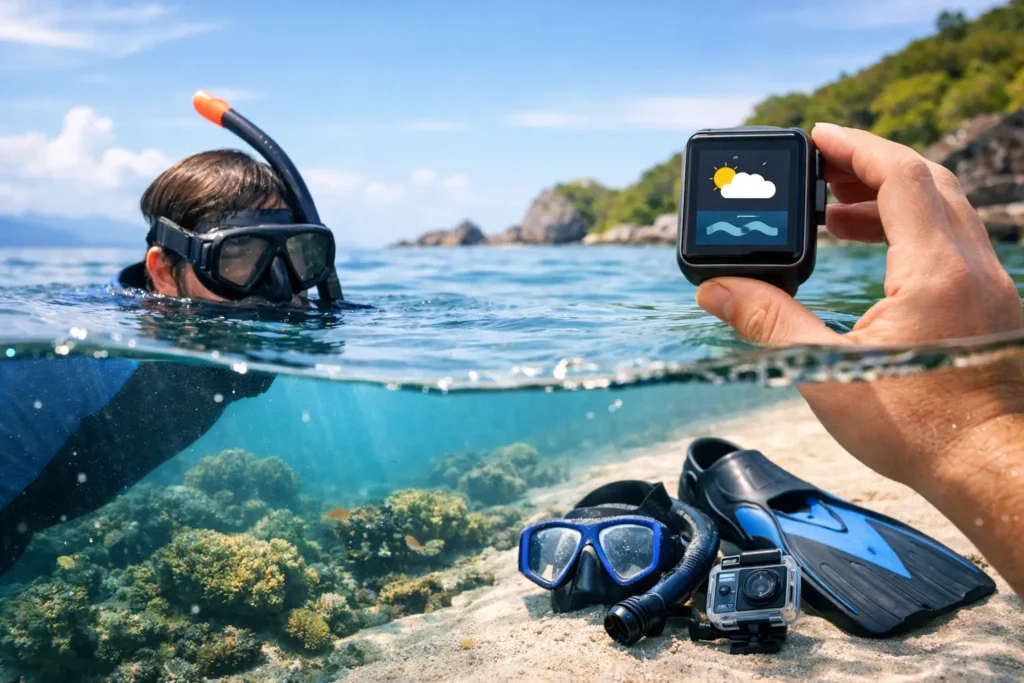
You can have flat surf, warm water, and blue skies and still end up staring into green-brown soup. Snorkelers know this better than most. A beach that looks inviting from the parking lot can be a total miss once your mask hits the water, and by then you’ve already burned the drive, the setup, and the window you carved out for the session.
That gap between what the coast looks like and what the water actually gives you is where most bad snorkel calls happen. Surface weather only tells part of the story. If you care about visibility, entry safety, and whether the session is worth it at all, you need to read the water like an ocean user, not like someone checking a generic forecast.
Why snorkelers get skunked by “good weather”
The big mistake is assuming calm-looking conditions equal clear water. They do not. Water clarity is shaped by several moving parts at once, and some of them can cancel out what looks like a promising day.
Wind is an obvious one, but it works in more than one way. Strong onshore wind can churn up sediment near shore and turn a decent reef cloudy fast. Even moderate wind over enough hours can degrade conditions, especially at shallow entries. Offshore or light wind often helps, but if the water was already stirred up the day before, the improvement may lag behind the forecast.
Swell matters too, especially period and direction. A small local wind swell can be annoying without ruining the session, while a longer-period swell can move a surprising amount of water onto reefs, rocks, and sandy bottoms. That movement stirs up suspended particles and reduces visibility even when the ocean looks manageable from shore. For snorkelers, that trade-off is huge – a spot can be physically swimmable but visually disappointing.
Then there’s tide. At some locations, incoming water brings cleaner visibility. At others, outgoing tide carries runoff or disturbed sediment into the area. Tidal swings can also change how easy an entry and exit feels, especially over reefs or uneven rock. The same beach can go from comfortable to awkward in a couple of hours.
Rain and runoff are the wildcard many people underestimate. It doesn’t have to be raining during your session for clarity to suffer. Storm drains, streams, and river mouths can keep pushing dirty water into the lineup long after the clouds move on. That matters for visibility, but it also matters for water quality. If a spot is near runoff and you’ve had recent rain, skipping the session may be the smart play.
What actually makes a snorkel session worth it
For snorkelers, a good session is not just about getting in. It’s about being able to see enough to enjoy the reef, spot marine life, stay oriented, and move comfortably without guessing what’s below you.
That sounds obvious, but plenty of people still judge a session by one variable. If the ocean is calm, they go. If the sun is out, they go. If the beach cam looks nice, they go. The better approach is to stack the signals. Ask whether the water will likely be clear, whether the entry will be easy, whether the current looks manageable, and whether your timing lines up with the best window instead of the most convenient one.
Timing is often the difference between a wasted trip and a memorable hour in the water. Early light wind can beat the afternoon chop. A cleaner tide push can outperform a mid-day slot that looked better on paper. Conditions are not static, and snorkelers who treat them that way usually miss the best windows.
How snorkelers should judge visibility before leaving home
Start with recent trend, not just the current snapshot. If a coast has had two days of onshore wind and elevated swell, a single cleaner morning may not reset visibility right away. Water takes time to settle. On the other hand, if the area has been stable for a few days, even an average-looking morning can produce surprisingly good clarity.
Next, think local. Broad forecasts flatten the details that matter most. A cove protected from a west swell can stay much cleaner than an exposed beach a mile away. A rocky shoreline might hold visibility better than a sandy one under the same conditions. Snorkelers who learn their spots stop asking, “Is the coast good?” and start asking, “Which entry handles these conditions best?”
That’s where a planning tool built for underwater users makes a real difference. Instead of piecing together wind, tide, swell, and random social posts on your own, you want one read on whether visibility is likely worth the trip and when the best window opens. Searu is built around that exact problem – turning scattered marine inputs into a usable clarity outlook for people who actually get in the water.
The safety side snorkelers should not brush off
Visibility is not just about seeing fish. It affects orientation, confidence, and decision-making. In poor clarity, distances feel different. Entries look easier than they are. Your buddy can disappear from view quickly. That matters even more around reefs, surge channels, and rocky points.
Snorkelers sometimes downplay this because the activity feels casual compared with scuba or other gear-heavy sessions. But casual is not the same as low-risk. A marginal visibility day combined with awkward surge and a solo plan can create problems fast. If you can’t clearly track your route, identify hazards below you, or keep visual contact with a partner, the session quality drops and the safety margin does too.
This is why the best planning is not just about chasing ideal water. It is also about filtering out days that are technically possible but not worth the exposure. Smart ocean users do this all the time. They save their energy, fuel, and gear prep for windows that actually line up.
Local knowledge beats generic forecasts every time
Experienced snorkelers build a mental map of how each spot behaves. They know which beaches tolerate a south swell, which coves clean up first after wind, and which entries get sketchy on lower tide. That knowledge is gold, but it usually lives in scattered conversations, old habits, and trial-and-error.
The problem is that trial-and-error is expensive. It costs time, gas, and missed sessions. If you’re traveling, it’s even worse because you do not have that local baseline yet. You’re making decisions in the dark with too many tabs open and too little confidence.
A better system combines data with real observations. Forecast signals tell you what should happen. Community check-ins and photo reports tell you what is happening. Put those together and snorkelers get what they actually need: confidence to go, confidence to wait, or confidence to choose a different spot.
Stop planning around hope
Hope is a bad filter for ocean decisions. It makes people overvalue a nice sky, ignore yesterday’s swell, and convince themselves that murky water will “probably be fine.” Sometimes it is fine. Sometimes it turns into twenty minutes of floating in low visibility wondering why you bothered.
Planning smarter does not mean overcomplicating the process. It means reducing the guesswork to a few useful questions. Is the water likely clear enough to enjoy? Is there a better time window if I wait a couple of hours? Is this the kind of day to bring a buddy without sending five texts and hoping someone replies? Those are practical questions, and they lead to better sessions than generic weather checking ever will.
For snorkelers, this mindset is the difference between reacting to the coast and reading it. You stop treating every beach day like a coin flip. You start recognizing patterns, timing your sessions better, and avoiding the false positives that waste the most time.
The best snorkel sessions are usually the most intentional
The people who consistently get good water are not always the luckiest. Usually, they are the ones who pay attention to trends, respect trade-offs, and wait for conditions to line up instead of forcing the session because it fits the calendar.
That can mean passing on a convenient afternoon for a cleaner morning. It can mean choosing a protected cove over your usual reef. It can mean skipping a spot entirely after runoff even though the beach looks calm. None of that is glamorous, but it works.
If you spend enough time in the ocean, you learn that the best call is often made before you leave home. Good visibility is not random. It follows patterns. The more clearly you can see those patterns, the less time you waste guessing and the more often you get in when the water is actually worth it.